
Emergency Air Duct Cleaning Near Me: What Hawthorne Homeowners Should Do First
If you’ve just discovered smoke, sewage, or confirmed mold in your ductwork, the first thing to do is shut off your HVAC system at the thermostat and circuit breaker. Running the fan while you search for a cleaner distributes whatever is in those ducts to every room in the house. In Hawthorne, most emergency duct situations are handled by either a specialty duct contractor or a restoration company, depending on what caused the contamination, and knowing which one to call saves you hours.
If you’d rather not sort through that alone, call (855) 473-3133 and we’ll help you figure out the right first move. We answer 24/7.
The First 30 Minutes Matter More Than Finding a Same-Day Appointment
Here’s what we tell homeowners who call us panicked about smoke in their vents or water in the trunk line: the fastest appointment in Hawthorne won’t help if the system keeps cycling contaminated air while you wait. The sequence should be power off, assess, document, then call.
Start by switching the thermostat to “off” and then flipping the breaker for the HVAC system. This matters because modern systems leak air even when idle. The blower won’t run, but the pressure difference between rooms can still move particles through the ductwork. In a Hawthorne house, where the duct runs are often up in a hot attic, that warm air rises and can push odor and fine particles through the registers without the fan ever turning on.
Here’s the triage order we recommend:
- Shut off the system at the thermostat, then the breaker.
- Close supply and return registers in rooms that aren’t affected if you can identify which ones are.
- Take photos immediately, before anything is wiped down or moved.
- Note the time you discovered the problem and the time you shut the system off.
That timestamp matters for insurance. A claim adjuster wants to know how long the contamination sat in the system before remediation started. An HVAC shut-off at 2:15pm documented with a photo of the breaker is a small detail that protects you later.
Only after the system is off should you start calling. In Hawthorne that usually means either a duct specialist or a restoration company, and the distinction depends on what got into the ducts in the first place.
Different Emergencies Need Different First Responses
Not every mess in a duct is an emergency, and not every emergency is cleaned the same way. The “emergency” label gets thrown around loosely in the air duct cleaning business, but the situations that genuinely justify immediate action fall into a few categories. Here’s how to handle each one before anyone arrives.
Fire and Smoke
If your house had a fire, even a small one contained to a single room, the smoke traveled farther than the flames did. Smoke particles are fine enough to stay suspended and get pulled into the return side of the system, and from there they coat the blower, the coil, and the inside of the ducts. Once they settle, the odor releases slowly for months, sometimes years.
Do not run the system to “blow out the smell.” That’s the most common mistake we hear about. It turns a localized smoke event into a whole-house odor problem.
Post-fire duct work should involve cleaning of the full system, not the ducts alone. The blower housing needs attention. The evaporator coil traps smoke residue like a filter. The return plenum usually holds the worst of it. If you’re in Hawthorne and the fire was more than a grease flare on the stove, check whether your restoration company handles the duct cleaning or whether you should bring in a separate duct contractor. Many restoration firms sub out the duct work, so you want to know who is doing it and with what equipment.
Water Intrusion and Suspected Mold
Water in the ducts usually comes from one of two places: a condensation overflow from the coil, or a leak in the house that ran into the return. Either way, standing moisture inside the ductwork is an open invitation for mold.
This is the point where you have to make a call about sequence. If you can see mold growing on the inside of the registers or smell a musty odor that gets stronger when the system runs, shut everything down and call a licensed mold assessor first, not a duct cleaner. A legitimate duct contractor in Hawthorne will tell you the same thing. The assessor takes air samples and a swab or tape lift to confirm what you’re working with. That test is the documentation that determines whether your insurance covers the work and what level of remediation is required.
Once mold is confirmed, the cleaning isn’t a routine job. It calls for containment, negative pressure, and equipment designed for contamination-sensitive work. Abatement Technologies systems are the kind of tooling used in those scenarios, because a consumer-grade vacuum recirculates fine spores instead of capturing them. We’d rather lose a job to a remediation specialist than see a homeowner get a cosmetic clean that leaves mold behind the registers.
Rodent or Pest Infestation
A rat that dies inside the ductwork creates a smell impossible to ignore and a biological hazard that shouldn’t be ignored. The first job is removing the carcass and any nesting material, then assessing how much of the system was trafficked. Rodents leave urine and droppings, and in the tight space of a duct run, their movement kicks up fine particulates that settle on the inside surfaces.
This is a full-system clean, not a spot treatment. The trunk line, branch runs, returns, and the air handler all need inspection and cleaning. In our experience, nests in Hawthorne are common in flexible duct runs in the attic, where animals can chew through the outer liner. While you wait for a technician, resist the urge to open the register and look inside. Disturbing the material releases more into the air, and if there’s an active animal in there, startling it can push it deeper into the system.
Sewage Backup
Sewage in the return air is the worst of these scenarios for a homeowner to deal with. Category 3 water, as it’s classified in the restoration industry, carries bacteria and pathogens that demand specific handling. The system stays off. The affected area stays blocked off. No one touches it without proper protective gear.
This is almost always a restoration-company job, not a duct cleaning call. The duct contractor’s role is the post-remediation cleaning and verification: once the restoration firm removes the contaminated water and structurally damaged material, the ducts themselves need cleaning and sanitizing. That’s the sequence: remediate first, then clean, then verify.
What ‘Emergency Duct Cleaning’ Actually Means in Hawthorne
The phrase “emergency air duct cleaning near me” gets typed into Google by people in Hawthorne who are scared, frustrated, or both. What they usually find is a mix of generalist HVAC companies and national chains that dispatch a technician with a portable vacuum and an inspection camera. That’s not an emergency response. It’s a scheduled appointment with a different name.
Here’s what the term should mean, and what you should expect:
- Same-day response is realistic for evaluation. A duct contractor can get to your Hawthorne home the same day you call, assess the system, and in many cases begin cleaning. What they usually cannot do the same day is a complete remediation of smoke-damaged or sewage-contaminated ductwork. That’s a multi-day scope with drying time and verification steps baked in.
- An emergency visit should start with containment, not cleaning. The priority is stopping the spread. That might mean sealing off a return, isolating a section of the trunk line, or placing a HEPA filter over a supply register. Only after the area is contained does cleaning begin.
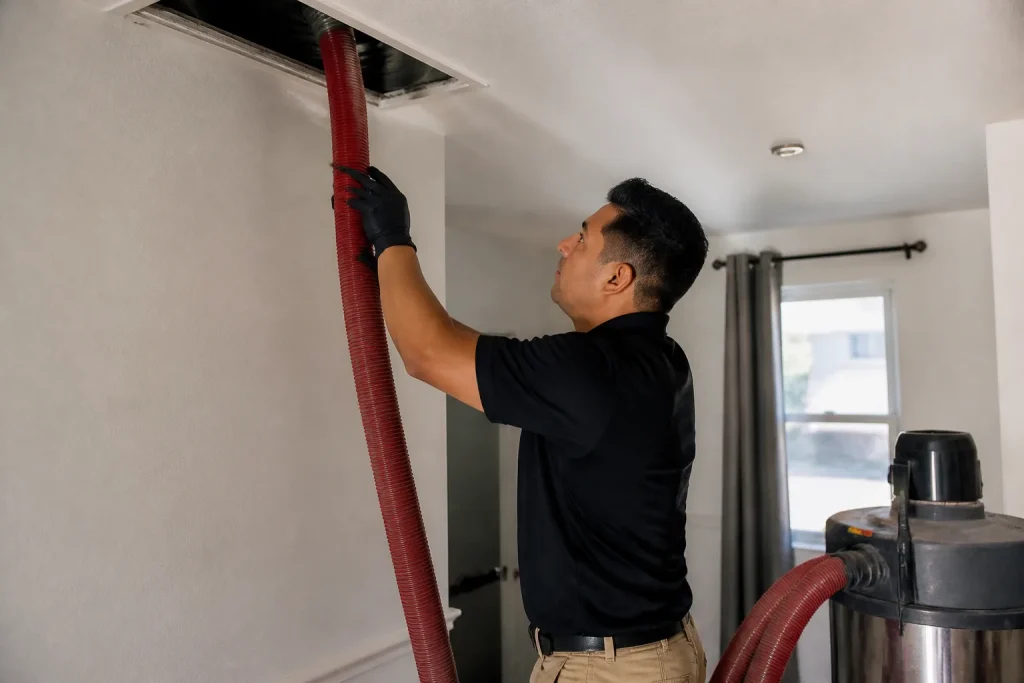
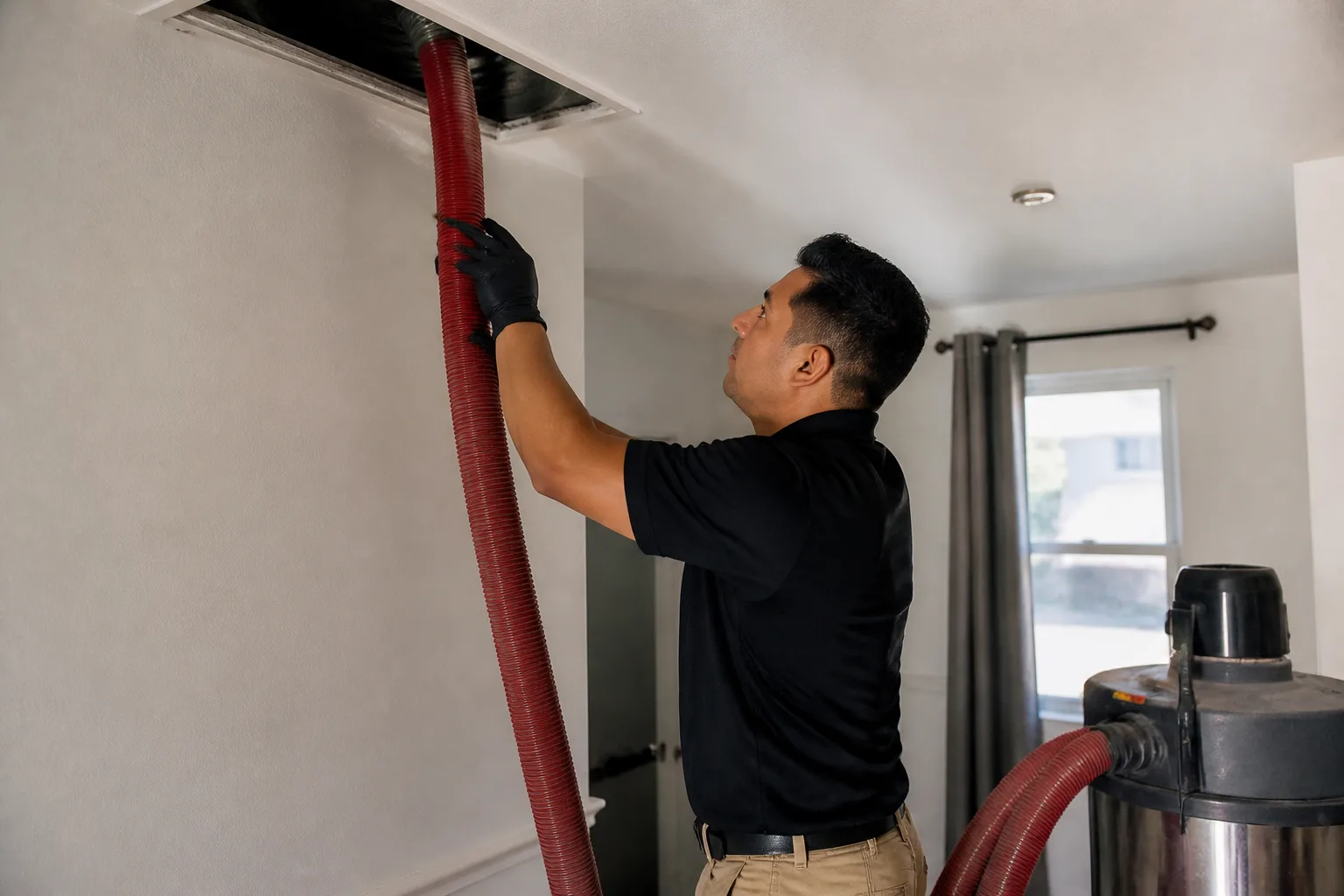
- The equipment matters more than speed. A system cleaned with professional extraction equipment from Rotobrush or Nikro achieves negative pressure and captures what’s removed. A shop vac with a brush attachment stirs contamination and sends fine particles right through the filter and back into the room.
We’ve been asked why we won’t promise a “done in two hours” emergency clean. The answer is that a real contamination event can’t be verified in two hours. The cleaning can happen fast, but the post-clean inspection, the pressure readings, and the visual verification of every register and return take the time they take. Cutting that short means handing the homeowner a receipt and a lingering odor.
Documentation That Protects Your Insurance Claim
You’re going to deal with an insurance adjuster, and that adjuster’s questions will sound like this: When did it happen? When did you shut the system off? What did it look like before anyone touched it? What did the air quality test show?
Here’s the documentation habit that serves Hawthorne homeowners best:
- Timestamped photos of the source. The water stain, the smoke residue on the register, the rodent nesting material. Take wide shots for context and close shots for detail.
- A written note of when the HVAC was shut off. Write it down or screenshot your phone’s clock when you flip the breaker. Your insurer will ask.
- Before-cleaning air samples if the situation involves mold or sewage. This is the piece most people skip because it costs a few hundred dollars and delays the cleanup by a day. It’s the strongest evidence you have. Once the ducts are cleaned, the evidence is gone. The sample taken before cleaning is the only proof of what you were dealing with.
- Equipment logs from the contractor. A credible duct cleaning company will provide before-and-after photos, static pressure readings if applicable, and a description of what was used. This isn’t the same as a detailed service report, but it should at least specify what was cleaned and how.
If you’re working with a restoration company in parallel, keep every email and scope document. Insurers in Hawthorne process claims more smoothly when the duct work and the restoration work are documented as separate scopes with separate justifications.
Post-Event Cleaning Standards: A Ticket Isn’t Verification
A visit summary that says “ducts cleaned” is not the same as a system that’s been verified clean. After a smoke or sewage event, someone needs to confirm the contamination is actually gone, not just that a service was performed.
NADCA, the National Air Duct Cleaners Association, publishes the standard most credible duct cleaners follow in the U.S. It’s called the ACR standard: Assessment, Cleaning, and Restoration of HVAC systems. Under that standard, the contractor evaluates the system, cleans all components that need it (not just the ducts), and then restores the system to its designed operating condition. The “R” is what separates the serious operators from the ticket-writers.
After a contamination event in a Hawthorne home, that verification step matters more than the cleaning itself. You want to see the inside of the supply trunk after it’s been cleaned. You want to see the blower housing. You want to hold the before and after photos side by side. If a company won’t show you that, the work isn’t verified.
We run professional-grade extraction systems from Rotobrush and Nikro, the same brands used in commercial and restoration-grade cleaning, not consumer equipment. That matters because smoke and sewage residues demand capture, not brushing. A rotating brush loosens material; a HEPA-filtered negative air system removes it from the house entirely. The distinction is the difference between a clean duct and a clean system.
When to Call a Pro in Hawthorne
If you have any of the following, the DIY window has closed and a professional is the right call:
- You can see mold on or inside the registers.
- You smell smoke, sewage, or decomposition through the vents when the system runs.
- Water has been standing in or near the return.
- You had a fire, however small.
- You found rodent droppings or nesting material inside a duct opening.
For any of these, the first service you need is Duct Cleaning Hawthorne, not a generalist HVAC company. A focused duct-and-vent contractor carries extraction equipment, understands airflow, and treats the duct system as the entire scope, not a bolt-on to a furnace tune-up. We also stock and install air-quality components from Honeywell and Aprilaire, so if the situation calls for improved filtration or humidity control after the clean, the upgrade is available in the same visit rather than being a separate call to another company.
Related services in Hawthorne: if the emergency involves a clogged or obstructed dryer vent, that’s a separate hazard and a separate service. Our dryer vent cleaning addresses the leading residential fire risk in most cities, and it’s usually handled in a single visit.
The Bottom Line
The first move in a true duct emergency is not a search query. It’s the breaker. Shut the system off, document what you see, and then call a professional who can identify whether you need a duct contractor or a restoration company. In Hawthorne, that distinction determines whether the job takes one day or one week, and whether your insurance claim survives first contact with the adjuster.
If you’re in Hawthorne and need help, Duct Cleaning Hawthorne offers free estimates. Call (855) 473-3133. We answer 24/7. Fast dispatch from 7am to 7pm, Sunday through Friday.
Frequently Asked Questions
A true duct emergency involves contamination that spreads through the system: smoke after a fire, sewage that entered the return, confirmed mold growth inside the trunk line, or a dead animal in the ductwork. If the system is running and recirculating any of those, the problem compounds by the hour. Shut it off and get a professional assessment the same day. For an immediate consult in Hawthorne, call (855) 473-3133 and we’ll help you triage over the phone.
Assessment and containment can usually be done the same day. Full cleaning of a smoke-contaminated or sewage-contaminated system is often a multi-day scope, because the process includes remediation, cleaning, drying time, and post-clean verification. A company that promises a two-hour emergency clean is usually selling a brush-and-vacuum visit, not a legitimate contamination protocol. Call (855) 473-3133 for a straight answer about your situation.
No. Adjusters and mold assessors need to document the condition before it’s altered. Take photos and collect air samples prior to any cleaning. Once the evidence is removed, your claim is harder to support. If you’re unsure about sequence, call us at (855) 473-3133 and we’ll walk you through what to do first. Estimates are free.
A duct cleaner removes debris and contaminants from the inside of the HVAC system. A mold remediation company contains and removes mold growth in building materials, including sometimes the structural parts of the building. When mold is inside the ducts themselves, both roles often overlap: the remediation firm sets up containment and removes damaged material, then a duct contractor cleans and verifies the interior of the system. In Hawthorne, start with a mold assessor if mold is confirmed; call us at (855) 473-3133 and we’ll help you determine the right order.
Written by the team at Duct Cleaning Hawthorne, serving Hawthorne since 2014.
Need Air Duct Cleaning Help?
Call Duct Cleaning Hawthorne - licensed & insured, here with fast help in Hawthorne.
(855) 473-3133